
Monthly Market Summary
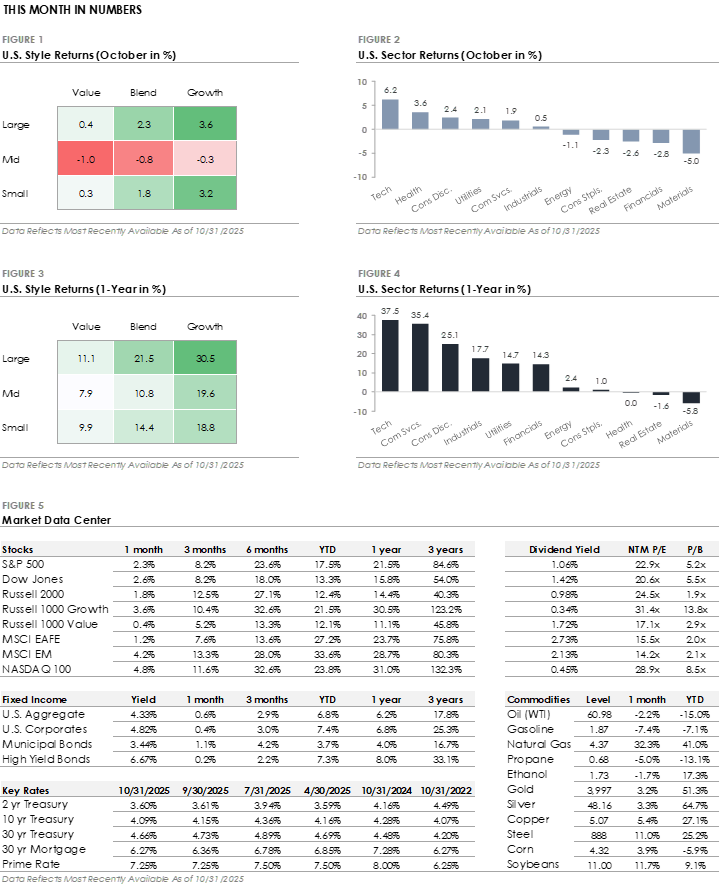
- The S&P 500 Index rose +2.3% in October, bringing its year-to-date return to +17.5%. Large Cap Growth stocks gained +3.6% and outperformed the index, while Large Cap Value returned +0.4%. Major stock indices set new highs, with the S&P 500, Dow Jones, Nasdaq 100, and Russell 2000 all posting a sixth straight month of gains.
- Technology led all S&P 500 sectors, with the Nasdaq 100 gaining +4.8%. Health Care and Consumer Discretionary also outperformed the index, while the remaining eight sectors underperformed, with five sectors trading lower.
- Bonds traded higher as Treasury yields ended lower despite intra-month volatility. The U.S. Bond Aggregate returned +0.6%, while corporate bonds underperformed. Investment-grade delivered a +0.4% total return, and high-yield gained +0.2%.
- International stocks split the S&P 500’s return. Developed Markets gained +1.2%, underperforming the S&P 500, while Emerging Markets returned +4.2%.
Federal Reserve Cuts Interest Rates as Government Shutdown Drags On
The government shutdown that began October 1st remains unresolved as of month-end, officially becoming the second-longest in U.S. history behind 2018. The shutdown, which is due to partisan gridlock over federal spending and health care subsidies, has disrupted government operations and caused hardship for federal workers. The market has mostly dismissed the stalemate as political noise, but the length of the shutdown is starting to raise concerns about its impact on consumer sentiment and business activity.
The shutdown has complicated interest rate policy by halting the release of economic data. Federal Reserve policymakers have had to make decisions without the latest data on the labor market, consumer spending, and housing market. Despite the data blackout, the Fed cut rates by -0.25% in October, its second consecutive rate cut. The decision reflects growing concern over labor market softening, with Chair Powell emphasizing that employment risks have overtaken inflation concerns, despite inflation still above the 2% target. The market expects another 0.25% rate cut in December, although the probability fell after Powell said a rate cut is “not a foregone conclusion”.
Stocks Trade Near All-Time Highs Despite Credit Concerns & Trade Tensions
Stocks ended October near all-time highs after they staged a late-month recovery. Credit concerns surfaced early in the month after multiple regional banks disclosed losses tied to commercial real estate fraud. The news came only weeks after two high-profile bankruptcies in the auto sector and reignited concerns about credit quality. Stocks initially sold off, but by month-end, concerns eased as credit rating agencies and analysts characterized the issues as isolated rather than systemic.
Around the same time, a sudden re-escalation of U.S.–China trade tensions rattled the market just weeks before a high-stakes Trump-Xi summit. It began when China expanded export restrictions on rare earth minerals, prompting the White House to threaten a 100% tariff on all Chinese imports if Beijing didn’t reverse course. The threats sparked a stock market sell-off and revived fears of a trade war. However, despite the harsh rhetoric and threats, both sides left room for negotiation. The Trump-Xi summit took place as scheduled in late October, and the meeting yielded several headline agreements that helped ease near-term U.S.-China trade tensions.
Market Sentiment: Cautious Optimism Ahead of Year-End
Market sentiment is cautiously optimistic heading into the final two months of the year, supported by the Fed’s rate-cutting cycle, continued enthusiasm around AI, and solid Q3 corporate earnings. November and December are historically strong for equities, and while investors are bullish, they’re not euphoric. Despite credit concerns fading and trade tensions easing, other risks remain. Valuations are elevated, investors are questioning the return from AI infrastructure spending, and job growth has slowed in recent months. Chair Powell’s pushback against a December rate cut tempered some enthusiasm, but hopes for a year-end market rally remain intact, even as attention shifts to 2026.
The information herein was obtained from sources which MarketDesk Research LLC (MDR) believes to be reliable, but we do not guarantee its accuracy. Neither the information, nor any opinions expressed, constitute a solicitation of the purchase or sale of any securities or related instruments. MDR is not responsible for any losses incurred from any use of this information.
Important Disclosures
The financial advisors at Phases Financial Group operate as independent financial advisors for Addison Avenue Investment Services. Financial advisors offer securities through Raymond James Financial Services, Inc. Member FINRA/SIPC, and securities are not insured by credit union insurance, the NCUA or any other government agency, are not deposits or obligations of the credit union, are not guaranteed by the credit union, and are subject to risks, including the possible loss of principal. Phases Financial Group is not a registered broker/dealer and is independent of Raymond James Financial Services. Additionally, First Technology Federal Credit Union and Addison Avenue Investment Services are not registered broker/dealers and are independent of Raymond James Financial Services and Phases Financial Group. Investment advisory services are offered through Raymond James Financial Services Advisors, Inc.
The information has been obtained from sources considered to be reliable, but we do not guarantee that the foregoing material is accurate or complete. Any opinions are those of Phases Financial Group and not necessarily those of Raymond James.
The information and opinions provided herein are provided as general market commentary only and are subject to change at any time without notice. This commentary may contain forward-looking statements that are subject to various risks and uncertainties. None of the events or outcomes mentioned here may come to pass, and actual results may differ materially from those expressed or implied in these statements. No mention of a particular security, index, or other instrument in this report constitutes a recommendation to buy, sell, or hold that or any other security, nor does it constitute an opinion on the suitability of any security or index. The report is strictly an informational publication and has been prepared without regard to the particular investments and circumstances of the recipient.
Past performance does not guarantee future results. The performance information shown herein is based on total returns with dividends reinvested and does not reflect the deduction of advisory and/or other fees normally incurred in the management of a portfolio. Performance and fundamental data is based on the following instruments:
Style Box Performance: Russell 1000 Value, S&P 500, Russell 1000 Growth, Russell Midcap Value, Russell Midcap, Russell Midcap Growth, Russell 2000 Value, Russell 2000, Russell 2000 Growth.
Sector Performance: S&P 500 Consumer Discretionary, S&P 500 Consumer Staples, S&P 500 Energy, S&P 500 Financial, S&P 500 Health Care, S&P 500 Industrial, S&P 500 Materials, S&P 500 Technology, S&P 500 Communication Services, S&P 500 Utilities, S&P 500 Real Estate.
Market Data Center: S&P 500, DJ Industrial Average, Russell 2000, Russell 1000 Growth, Russell 1000 Value, MSCI EAFE, MSCI EM (Emerging Markets), NASDAQ-100 Index, Bloomberg US Aggregate, ICE BofA US Corporate, ICE BofA US Broad Municipal, ICE BofA US High Yield.
Fixed Income Yields and Key Rates: Bloomberg US Aggregate, ICE BofA US Corporate, ICE BofA US Municipal Securities, ICE BofA US High Yield, 2 Year US Treasury Bond, 10 Year US Treasury Bond, 30 Year US Treasury Bond, 30 Year US Fixed Mortgage Rate, US Prime Rate,
Commodity Prices: Crude Oil WTI (NYM $/bbl), Gasoline Regular U.S. Gulf Coast ($/gal), Natural Gas (NYM $/mmbtu), Propane (NYM $/gal), Ethanol (CRB $/gallon), Gold (NYM $/ozt), Silver (NYM $/ozt), Copper NYMEX ($/lb), U.S. Midwest Domestic Hot-Rolled Coil Steel (NYM $/st), Corn (CBT $/bu), Soybeans (Chicago $/bu),